Archive

Archive for the ‘Europe’ Category

Mobile Marketing Trends: Mobile OS Wars – Is There Life Beyond Android and Apple?

January 30th, 2013 2 comments

apple samsung behind scenes

Back in 2010 I looked at the mobile market dynamics and OS market share statistics in the US and Europe, as all marketers talked about was Apple, iPhone apps and Apple’s products. In reality, was it all about Apple? Not really.

In those days Android had started eating slowly, but steadily iOS market share, and Symbian OS was still dominating Europe.  2010 seems like a long time ago – things have really changed.

Last year was full of lawsuits, clever advertising, product launches, failed mapping headlines, and a whole lot of drama between Google, Samsung and Apple. But … is it really all about Samsung and Apple?

Samsung vs. Apple – a clever PR stunt?

In 2012 Samsung established a very strong position as an Android developer fighting against Apple and received strong support from the Android community … and from a part of the media as well. But is this battle really that strong or did these two companies take advantage of the tension between Apple and Android fans to fuel the fire and get their names out there? Looking back at the big amount of Samsung vs. Apple law suits and the cocky “apology” to Samsung by Apple, it is possible. And if they did, it worked: for a month or two all media and people talked about was Samsung / Google vs. Apple. You had to make a stand – either you were Android fan or an Apple fanboy. It was all or nothing. All nicely timed with iPhone 5 launch as well as Galaxy launches.

Samsung became almost a symbol of fight against overly-confident Apple, but there are much more great Android developers out there including ASUS (creator of the highly successful Google Nexus 7 and Nexus 4), HTC, Sony, etc. But did anyone talked about them in Google vs. Apple battle? Not really.

So what is really happening behind the scenes?

Constantly changing mobile market dynamics

1.5 billion handsets were shipped in 2012, a 2% increase compared to 2011. 700 million of the handsets were Smartphones, yet even if the global smartphone shipments increased by 490,5 million units (43%), the saturation in Western Europe and North America impacted the slower growth.

Samsung, Apple and Nokia were named the top three vendors with Samsung shipping 30% of the handsets in 2012. Company’s Smartphone sales were mainly fueled by its record sales of the popular Galaxy models (396.5 million) yet the total handsets it sold were 400 million. Apple shipped 135.8 million iPhone units (19%) strengthening its position in North America, but the company failed to reach developing markets such as Africa as well as certain European countries. Meanwhile Nokia’s market share dropped in 2012, but the launch of Asha and Lumia 920 / 800 had a positive impact in Q4 2012 with 86.3 million units sold, in which smartphone accounted for 15.9 million units composed of 9.3 million Ashas, 4.4 million Lumias and 2.2 million Symbian smartphones. Chinese handset manufacturer ZTE settled for fourth place.

Mobile OS market share in 2012

According to Kantar Worldpanel ComTech, Android has shown strong growth in Europe and Australia in 2012 and is holding now 61.1% of the EU5 and 55,8% of Australian market share. The growth has been significant in Britain, France and Spain in the EU5, but increase has been slow in Italy and its market share has decreased – surprisingly – in the USA. What comes to other markets, in Brazil Android increased its market share to 47.1% and in Mexico to  37.3%.

statistics OS mobile europe us australia

What comes to iOS, despite iPhone 5 and iPad mini launch, iOS market share in the EU5 has increased only 0.2%. The biggest growth in EU5 happened in Italy and France, yet the iOS market share decreased 1.7% in the UK and Spain. The US market share increased 6.3%, while Australian market share shrunk 3,4%.

In Europe Windows Phone’s market share has more than doubled to 5.4%. The strongest market in EU5 for Windows phone is Italy with 13.9% of the market share (11.1% increase from 2011) and Britain with 5.9% market share (up from 2.2% in 2011). However, the growth has been slower in other EU5 countries, Asia and the US. In Brazil the market share has jumped up to 12.2% and to 2.7% in Mexico.

Symbian OS, Bada and Blackberry’s RIM have suffered the market changes most in developed countries.

Mobile market in 2013

Apple seems to be struggling with a falling market share – and shares. The launch of the iPhone 5 in 2012 was a disappointment for many, and especially Apple’s infamous maps have created headlines. iPad mini launch was also the first time when Apple moved from innovator to a follower by comparing openly iPad mini with Google Nexus 7 in the official press conference. Is launching a new model so rarely Apple’s strategy to make the products more special? Or is there perhaps nothing new to publish?

Anyhow, Apple has still a very strong ecosystem and it has done a brilliant job on introducing Apple products in all aspects of user’s life from home stereos and in-car assets to music and apps. Once you have bought Apple related things during years it is very difficult to switch to another Smartphone / tablet. That being said, Apple has made “switching” to other OS a bit easier with the introduction of the new cable, which means the things you bought for your previous iPhone are not compatible with iPhone 5 or any other new model Apple launches.

There has also  been a lot of speculation whether Nokia made the right choice of choosing Windows phone OS instead of Android. Maybe it did. If Nokia would have picked Android as an OS, what would differentiate it from other Android developers in Samsung’s shadow? It will be fascinating to see whether Windows phone platform keeps growing strongly. Other interesting game changers to watch in 2013 are Blackberry 10, and Linux / Ubuntu based devices.

Android is going strong, but we might see a change from a role as a market challenger to a leadership defending OS. And the OS with the biggest market share tend to get challenged by the smaller OS – just what happened to Symbian and Apple. As mobile market is changing so rapidly, it could be possible that in two years time Apple has become a dinosaur, Android / Google the bad guy and Windows phone the new trendy platform … and the fighter of justice.

Mobile Marketing Trends: Samsung Galaxy S III Launching First in Europe

May 7th, 2012 No comments

galaxy-s3-launch-europe“It sees us”,

Samsung representative, Galaxy S III London Launch


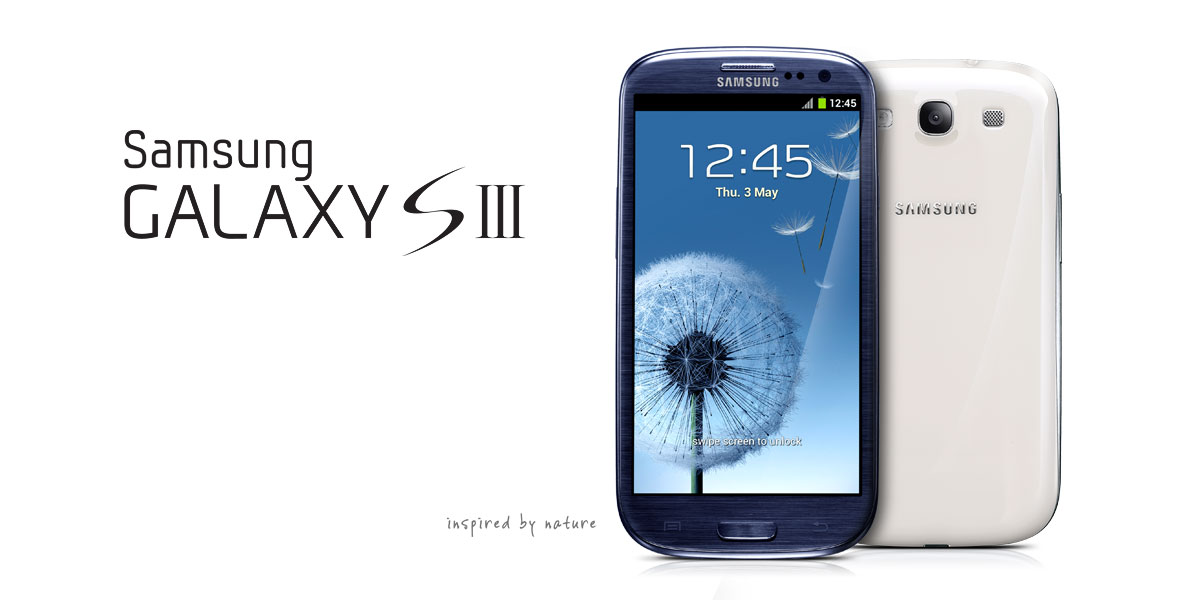
Samsung’s new Galaxy S III is smart … very smart. The mobile manufacturer unveiled last week in London the highly expected addition to its Galaxy S family, after creating a lot of hype around its launch. Even if the launch event itself was not as impressive as Nokia’s Lumia’s, the new Smartphone makes iPhone look a bit “old school”. Maybe the iPhone5 launch is so delayed, because Apple needs to reinvent phone’s features after each Android launch to seem innovative? Who knows…

Very Smart Mobile Technology

Besides its big screen size and 720p resolution, Samsung Galaxy III is differentiating itself from the competition with eye tracking capabilities. The technology called Smart Stay allows the front facing camera to monitor your eyes and know when you are looking at it. This allows the mobile not to “sleep” from inactivity if you are watching a film or reading an e-book, for example.

Other interesting smart feature called Direct Call is well adapted for real life. For example, if you are sending a SMS to someone, but decide it is actually simpler to give him a call, you can move the phone next to your ear to make a phone call to that number. With the Beam sharing function, that combines NFC technology with Wi-Fi Direct, you are able to share movies and music with other phones by simply tapping them. You can also throw content to TVs, as well as make the TVs mirror what is on your Smartphone screen.

The mobile device uses ‘S Voice,’ an advanced natural language user interface, to listen and responds to your words. You are able to use it to command the phone with only your voice to snooze, play songs, turn the volume up or down, send text messages and emails, organise your schedules, or take a photo. It is to be seen whether it understands the Scottish accent better than iPhone’s Siri.

Samsung Galaxy S III Launching First in Europe

Samsung announced that it will launch the 3G version of the Galaxy S III end of this month, and 4G version is arriving later this summer. Surprisingly the manufacturer has decided to launch first in Europe on 29th May, before launching in the North America in June. There has also been rumours that the phone would be launched before the USA also in Asia, Africa, and Latin America. Interesting choice. One of the reasons might be the objective to strengthen Samsung presence in the other continents as it has a strong presence already in the USA.

According to IDC, the global sales for mobile devices (feature and Smartphones) increased 11.1% in 2011 compared with 2010 with Nokia leading with 27%, Samsung with 21.3%, Apple with 6%, and LG with 5.7% of the global mobile market share. The top device manufacturer by market penetration rather than sales is Nokia in Western Europe, Samsung in the US and Sharp in Japan.

Top mobile manufacturers, by market penetration, Q4 2010, according to ComScore (2/2011)
USA Japan Germany UK France Spain Italy
1 Samsung 24.8% Sharp 25.3% Nokia 33.1% Nokia 30.4% Samsung 34.1% Nokia 47% Nokia 47.4%
2 LG 20.9% Panasonic 15.0% Sony Ericsson 18.2% Samsung 19.4% Nokia 20.6% Samsung 15.3% Samsung 21.4%
3 Motorola 16.7% Fujitsu 11.7% Samsung 17.8% Sony Ericsson 13.7% Sony Ericsson 10.7% LG 10% LG 7.2%

What comes to only smartphones, according to IDC, also smartphone sales showed strong growth worldwide in 2011 the global sales growing 31.8% in 2011 compared with 2010, and Smartphones represented 31.8% of all handsets shipped. Samsung leads the way with 19.1% market share, Apple follows closely with 19%, Nokia is third with 15.7%, RIM with 10.9%, and HTC is fourth with 8.9%

Samsung Galaxy S III to conquer Europe?

It is an interesting phone with interesting features, but it does not seem world changing. It seems more like a refreshed version of their already successful model. However, as the company is planning pop-up stores across Europe to give customers the possibility to play with the Galaxy S III, I am hoping to see a stream of American tech tourists arriving to Europe to get it – just like we used to travel to the USA to get an iPhone.

And yes, I will be happy to go and play with the Galaxy S III as well.

Social Media Trends: Pinterest in Europe – Pin it or Bin it?

April 21st, 2012 No comments

Pinterest in EuropePinterest. Surprise, surprise – another new social network everyone talks about. There is a lot of hype around the platform, but is it really necessary to invest again money, time and resources in another social network?

Yes. There is actually a very good reason why Pinterest should not be ignored: the total number of global unique visitors in Pinterest increased 2,702.2% since May 2011 reaching 11,716,000 visitors by January 2012. It has 1,36 million visitors a day.

What is Pinterest?

Pinterest is a social photo sharing network that allows people and brands to create image collections, Pinboards, based on their interests, hobbies, products, beliefs, humour, art, events and more. The idea is to connect people through the things they find interesting and get inspired by. Users are able to browse other users’ collections, re-pin images for their own Pinboard, follow other users, and like their photos. Pinterest allows users to share pins also on other social networks, which increases the social visibility.

Pinterest – user demographics and engagement

The average Pinterest user spends almost 16 minutes on the site per visit compared to 16.4 min. in Youtube, 12.1 min. in Facebook, and 3.3 min. in Twitter. Surprisingly, Pinterest provides more referral traffic to other sites than Google+, YouTube and LinkedIn combined together, and the apparel retailer referral traffic from Pinterest increased 289% between July and December 2011.

50% of the Pinterest users have children, almost 70% of Pinterest users are female, and 97% of Pinterest’s Facebook fans are women. Instead of teenagers and young adults, the platform seems to appeal most for the older age groups: largest age group is 25-34 year olds (27.4%) followed by 35-44 year old users (22.1%). Interestingly 45-54 year old users represent 17.9% of the user base, which is a high number compared to other social networks.

Pinterest in Europe

In Europe Pinterest has grown exponentially since May 2011 becoming the fastest growing social network. According to Comscore, in January 2012 the UK had the highest number of unique visitors in Europe (245,000), Germany had 67,000 unique visitors, and Spain had 62,000 unique visitors. What comes to the growth, from May 2011 to January 2012 Germany had the highest growth rate of 2956% in Pinterest, followed by Spain (1348%), and Italy (794%).

Pinterest statistics Europe 2012Even if the unique visitors decreased in France and the UK between December 2011 and January 2012, engagement on Pinterest increased by 1740% and 20%, respectively.

Is Pinterest worth investing?

Pinterest is currently the fastest growing social network in the US and Europe, and it is very interesting from a brand perspective. You have a possibility to target people according to their interests in real time without being their “friends”, provoke a stronger response with images as people are very visual, and obtain social recommendations when people “pin” or like your image. With a proper preparation, the social photo sharing platform may be very beneficial for sales,  and looking at the demographics, it is great especially if you are targeting women and more mature demographics.

How brands can use Pinterest? For example, ecommerce sites and brands can use Pinterest to pin their products (fashion, clothes, shoes, accessories, interior designs, household items, wedding items, baby products, etc), travel companies and hotels can pin location pictures, food manufacturers can pin beautiful dishes, pet food companies can pin cute animals, etc. etc. The list goes on, but as with other social networks stop and think before you start pinning. Pinterest has a lot of potential, but if not done properly the end result may not be what you expected. To be successful as a brand you need a proper Pinterest strategy to reach right people, and if you have a good strategy  – an image can be worth a thousand words.

EU Data Cookies Law: What Does It Signify for the Website Owners?

March 18th, 2012 No comments

We have been aware of it for almost a one year, but unfortunately the lawyers in EU headquarters are not changing their minds as we secretly hoped. The new EU data cookies law will be effective from 26th of May 2012 in the UK, but very rare companies have done something about it. Now we only have two months left.

What is a Data Cookie?

Cookie is a small file that is downloaded onto your device when you access a website, and it sends your information back to the site once you access it again. Cookies are used in most of the websites – for example, eCommerce site stores delivery details to fasten the checkout, Google analytics (one of the most common cookies) uses cookies to provide statistics for the website owners, and Google also uses them in Google search to provide more personalized search results and adverts.

The reason why cookies are so important for companies is the statistics and results they provide. These allow website owners to analyze the data and take actions to optimize the website performance. Marketers also need the results to justify the digital investment for the top management and investors.

What is the New EU Data Cookies Law?

The European Union Cookie law – or the Privacy and Electronic Communications (EC Directive) Regulations 2003 – was created to assure that website users have a choice whether the website can collect their information or not.

It means that cookies or similar devices must not be used unless the website subscriber or user:

(a) is provided with clear and comprehensive information about the purposes of the storage of, or access to, that information; and

(b) has given his or her consent.

However, device finger printing as a way of user identification is allowed.

What does the EU data cookies law signify for companies?

From May 26th 2012 companies must inform users about the cookies on their website, what the cookie is doing and ask actively users permission to use that cookie. Besides websites, devices like mobile phones, internet-connected TVs and gaming consoles require the same level of compliance.

How this is done in real life without spoiling the user experience? Well, that is a good question.

If the user does not give permission to use cookies, companies will have no track record of their visit, which means that visitor numbers are going to drop record low. It will also be extremely difficult to track website and campaign performance. Not only there is a great quantity of own and third party tagging, but do not forget the quantity of embedded YouTube videos, widgets, social log-ins, plug-ins etc. which also want to use cookies. Who will explain the Facebook cookies – the website owner or Facebook?

How to ask users permission to use cookies?

There are not many examples how companies are asking users permission to use cookies in real life. This is most probably because companies do not want to add an annoying message to their website until they absolutely have to. And of course companies prefer seeing what competitors are doing first and then possibly copying the message to their website. Of course the Information Commissioner’s Office (ICO) website had to provide an example. Not a great one to be honest, since if user ignores the message and does not click “accept” you cannot track them. It meant that ICO’s analytics data regarding the unique visitors dropped 90%.

There are however few options, such as:

  • Modal dialogue box, which explains in detail what cookies are on the site and what they do. It is shown as a layer and does not allow user to interact with the site until they opt-in or opt-out
  • Status bar, which appears in the top or bottom of the page. It informs users that cookies are used on the site and user needs to opt-in or opt-out to close it.
  • Warning bar, which appears every time the website wants to use a cookie asking user to either accept or decline it.

How this is implemented in mobile, TV or tablets? I do not know. Maybe one option is to start by having a link advicing users of the new privacy policy, which then leads to a page explaining in more detail what the cookies are, why they are used, how they improve the site functionality, and explaining how the user can disable them in their browser (if they really want to).

Whatever you do, it is not worth waiting for 26th May 2012 to see what competitors are doing or you might risk a 500,000£ fine. It is better to start thinking and experimenting with AB testing now before it is too late. Of course usually the government does not act until someone complains – but do you really think that some of your competitors would not be happy to tip you off?

Europeans Addicted to Social Media: 47% of the Mobile Users Access Social Networks Daily

November 24th, 2011 No comments

Social Media, Social Networks, Social Commerce … there is no escaping social these days especially after the launch of Google+. We communicate with the consumers via wall posts and tweets, build our business network in LinkedIn instead of meeting face-to-face and handle customer service via Twitter. But maybe we are right to become so obsessed with Social Media.

According to an European comScore MobiLens study, the mobile social networking has increased  44% in France, Germany, Italy, Spain and the UK during 2011. What is even more interesting is that more than 40% of the European Mobile Social Networking users are engaging with brands.

 Snapshot of the 2011 European mobile market

  •  UK and Spain are leading countries in Smartphone usage with 46.9% and 46.3% penetration respectively, compared to the European average of 40.1%. Germany has the lowest Smartphone penetration with 33%.
  • British and Spanish mobile users also use non pre-installed apps above European average of 34.5%, UK with 44.9% and Spain with 35.4%. Germans have the lowest percentage with 30.4%.
  • 46.9% of the mobile users in the UK and 35.3% in France use browser, compared to the European average of 35%. Germans users browse the least with 28.4%.
  • 33.8% of the British , 30.1% of the Italian and 28.7% of the Spanish users play mobile games, compared to the European average of 26.5%. French users play games the least with 15.6%.
  • Sending text messages is the most popular mobile activity across all five European markets, the average reaching 82.9%.
  • 32.6% of the Spanish mobile users listen to music, above European average of 25.9%. Only 23.3% of the French use mobile to listen to music.
  • 35.1% of the UK mobile users access news, way above European average of 18.5%. Germans are the least interested on news, with 15.7%.
  • 35.1% of the UK mobile users access social networks and blogs well above average of 23.5%. Germans were the least social with 17.3%

 Increasing mobile social network addiction

 55.1 million European mobile users accessed social networks or blogs via mobile devices in September 2011 only, representing 23.5% of the total mobile audience. Not only did the mobile social media usage nearly double, but 47% of the users accessed social networks and blogs daily.

“Over the past year we have seen social networking use grow rapidly among mobile users across Europe, driven largely by the growth in smartphone adoption, making it easier than ever for users to stay connected and engage in social activities while on-the-go,” stated Jeremy Copp, comScore Europe vice president for Mobile. “More notably, the rate of growth in daily social networking usage has surpassed even the rate of growth in total social networking adoption among mobile users, suggesting that the behavior is becoming even more ingrained into people’s daily mobile lives. As social networks continue to invest in improving the user experience on mobile devices and tablets, it will be interesting to see how social behaviours on the mobile platform further evolve.”

 Interestingly, while most of the European mobile users accessed social networking sites via browser (31.3 million), the usage of social network mobile apps doubled to 24.2 million.

Mobile Social Networking Activities

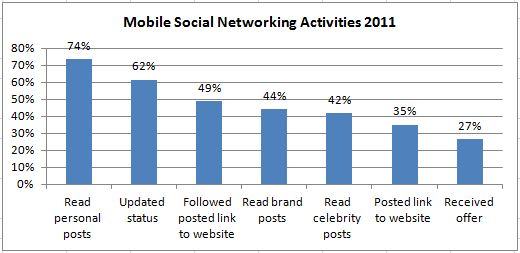
Finally good news for marketers: 44% of the mobile social networking users admitted reading posts from brands and about 27% reported receiving offers, coupons or deals on their mobiles.

 What comes to other activities, 74% of the users read posts from people they know and 62% updated their status. Peer recommendation also has an important role with 35% of the users posting links to websites and 49% of the users following posted links to websites.

Leading European mobile social networks

In 2011 Facebook increased its European mobile audience 54% up to 39 million. This represents 71% of the EU5 mobile social networking audience positioning Facebook as a clear leader. However, even if the social network gathered the most users, it did not experience as big growth as its competitors: Twitter grew its mobile audience 115% up to 8.6 million, 2.2 million unique users accessed LinkedIn increasing network’s mobile users by 134% and the Spanish social network Tuenti grew by 60% gathering 2.3 million unique users.

Go social, think local

The results highlight the importance of Social Media in European brand communication strategy. With localized mobile site and social network pages brands can increase user engagement and user referrals, and the little snapshot of the social media activities can provide some insight to the best tactics in each country. While building a game app seems to work in the UK and Spain, a mobile game might not be very successful in France.

Reaching European audience is tricky because of the different languages, cultures and customs, but for brand to engage with the European audience, social media seems like a good starting point.

EMEA Tablet Market to Triple in 2011, but Apple, not Android, Dominates Europe

August 14th, 2011 No comments

According to a research firm IDC, tablet market in Europe, the Middle East and Africa (EMEA) made up about 33% of last year’s global sales. The company also estimates that the EMEA media tablet market will more than triple in 2011 to reach 22 million units.


However, research firm Forrester predicts that tablet market in EMEA will account for 14.5 million units, or 30%, of worldwide consumer tablet sales in 2011. Not as positive prediction as 22 million units, yet the research firm indicates that more than 43 million Europeans say they are interested in buying a tablet in the future.

Apple, not Android, dominates Europe

Despite recent Android launches in Europe, Apple still has 70% market share for tablet sell-through to consumers in Europe. It means that other tablet makers have product in retail channels, but it is not moving nearly as quickly as Apple’s iPad. Main reason is that non-iPad tablet competitors’ content ecosystem, applications and channel strategy are not as effective as Apple’s and their tablets’ prices are perceived too high.

Apple’s weakness outside the UK

However, Apple has a smaller number of Apple store outlets across Europe (52) compared to its more extensive network in the U.S.(240). What makes this even more interesting is that 30 of these Apple stores are located in the UK, leaving 22 for the rest of the Europe. It means that Apple could be vulnerable to competition outside the UK, since Apple’s brand and channel presence is not as strong in the continental Europe. For example, Mac ownership is lower in all EU-7 countries than it is in the U.S.

This weakness could give Samsung, HP, Acer and Research in Motion a chance to gain more market share in Europe yet if the prices remain the same, there is a danger that low-cost tablets from ODMs such as Huawei and ZTE will enter the market quickly and steal market share.

No content or apps? No customers.

Yet even if consumers like low prices, being cheap is not enough to make them purchase the product. For tablet to be successful in Europe it has to be user-friendly, and have attractive content and useful applications both for free time as well as business purposes. In a very culturally diverse Europe it is very important to have local content providers, because English is simply not enough.

What comes to t-commerce, most of the tablet owners find shopping with the tablet more engaging and a study by e-commerce platform provider Shopatron, supporting more than 800 brand stores in 35 industries, claims that the conversion rate from tablets is much higher than conversion rate from mobiles or even PCs. According to the study, the average conversion rates for non mobile optimized pages (iPhone, Android, iPod…) was an average of 0.37%, yet the average conversion rate from iPad was a whopping 2.04%.

This means that t-commerce is another aspect tablet developers need to take in account while optimizing the user experience.

Anyone to challenge Apple?

Even if there are many competitors rushing into European market, Forrester argues that at the moment there is no serious iPad challenger on sight. This will not change and people will keep on buying iPads unless a competitor with competitive price, quality hardware and successful content ecosystem emerges.

Google might just do this. The search giant has agreed to pay $12.5bn in cash for Motorola Mobility to move  decisively into the hardware and into even more intense competition with Apple and Microsoft. Larry Page, Google’s CEO, said the reason for the move was to “supercharge the entire Android ecosystem for the benefit of consumers, partners and developers”.

What would be interesting to see is Nokia and Microsoft taking on the challenge to compete with the two. Nokia is known around Europe for its high quality and Microsoft office programs would result very attractive and familiar for European business users. If Microsoft does not invest in mobile and tablet market, the company will see its market share diminish. Nokia meanwhile has also strong reputation in emerging markets, which could help them to keep their market share.

In the end of the day, Nokia still has the strongest foothold in European mobile market even if all we hear about is Apple and Android. But as we Finns say: empty barrels make the most noise.

E-Commerce: Online Green Retail Spending 3.5bn Euros, Purchases to Double by 2012

May 22nd, 2011 No comments

“Sales of green products will not become commonplace until suppliers give consumers better price incentives in-store and online to follow their consciences,”

Bruce Fair, Kelkoo Managing Director

Despite of the recent ecological disasters and constantly increasing environmental awareness, the green retail market holds only a small percentage of the total retail purchases in Europe. Although the total green sales have increased by 114% since 2000, the market accounted for only 2.5% of total European retail sales in 2009. This is not highly surprising, considering that the European consumers are charged on average 46% more for green non-food items and 25% more for green food items than for standard products.

Increasing green demand

However, according to the “Centre for Retail Research Green Buying Guide,” a study conducted in 2010 for Kelkoo, it is predicted that green product purchases will double from 56 billion Euros to 114 billion Euros by 2015, capturing a 5% share of the European retail market. The price of green products will also decrease by 13% by 2012, decreasing the price difference from 46% to 40,5%.

European households will increase their green spending from 386 Euros to 751 Euros per year by 2015. Germany (30.2 billion Euros), France (21,7 billion Euros) and the UK (19,8 billion Euros) will keep their position as the biggest green economies, while Switzerland (1133 Euros/household), Sweden (873 Euros/household) and Denmark (843 Euros/household) have the highest green spending per household in Europe.

Price main obstacle for purchase

The green market in overall has been increasing due to change in consumer attitudes and behaviour, government and company environmental policies and increasing environmental awareness. The main reason why it has been increasing so slowly is the cost. While demand for energy-saving products such as energy-efficient appliances and light bulbs helping consumers to save in long term has soared especially during recession, the demand for less “pocket-friendly” organic green goods has suffered. Unless suppliers make green products available at a reasonable price, the demand stays highly dependable of consumers’ buying power, however environmental friendly they might be.

Online green retail spending increasing

However, a very interesting fact that came up in the Kelkoo study is that European E-Commerce sales of green products account for 6.2% of all green retail spending with 3.5 billion Euros and is constantly increasing. Interestingly, consumers buying green products online do not do so only because they are on average 11% cheaper, but because the selection is larger than in stores close by and it results a more convenient way to purchase.

For an ecological brand Green E-Commerce might be an interesting opportunity to increase awareness and demand of the green products among environmentally friendly consumers, especially when it will decrease the dependence of the supermarkets, eco-stores and rest of the supply chain. By cutting off different providers on the way to the consumer, it is actually possible to offer the product with a reasonable price to fuel the consumer demand. Green is still fashionable and people want to buy it despite of the recession – by establishing a trustworthy online reputation through Social Media and consumer forums and by providing a convenient, user friendly e-commerce platform the green brand is able to increase its market share. Not only in one country, but across Europe.

However, in the time of green-washing it is very important to create a believable eco-brand. Discover the top tips here.

Global Marketing Trends: Population Is Aging, So Should Your Brand.

May 15th, 2011 No comments

We all want our brand to be attractive, exciting, trendy, sexy and … young. Our society adores youth, we want the young generation to buzz about us, brands and campaigns winning awards are aimed to youth. Facing declining sales, we cannot help hearing that we must rejuvenate, rejuvenate, rejuvenate…

However, many times there is a big conflict between the people we want to buy our brand and the people who actually buy it. Too many times the marketing and communication target is 20-30 years younger than the loyal consumers forming the grand majority of the database.

Cosmetic “brand” surgery?

Some brands tackle this by going through a long process of changing their brand image. More or less successfully. Ford experienced this problem in Spain with its upcoming launch of the new, young, trendy Ford Fiesta. In Spain this particular car model was perceived as a car for 40-50-year-old women, but few years before the launch, Ford Spain started creating a community especially for youth www.maskedummies.com. The booming trendy community changed slowly the image of Ford Fiesta and made the marketing message more believable in 2008. Another example of successful change of brand image is of course Old Spice.

But is it really so bad to be a brand for “old” people? What if the sales are declining, not because our brand is getting older and new generation does not buy it, but because we are ignoring the older generation who does?

Aging global population

With the declining fertility and improved health and longevity, the population aging has become the biggest demographic trend globally. In 2009 the global population of +60-year-old people reached 680 million, 11% of the world’s population. It has also been predicted that by 2030, the amount will increase to 20% in 55 countries.

By 2050, Europe will increase its elderly population from 40 million to 219 million, China will experience a growth of 30% from 109 million to 350 million and India will increase the number of elderly from 62 million to 240 million. Japan, with the largest percentage of +60 people, will increase the current amount from 27% to 44%.

While number of youth decreases across the planet and the number of older people increases, does it not make more sense to take advantage of the “older” brand image instead of investing resources and money to desperately rejuvenate the image? Older people are more loyal to the brand than the new multitasking and impatient generation. Besides – they have also more money and time to spend.

Aging Social Media and Blogosfare

Yes, but young people make more noise in the Internet you might say. Not true.

In January 2011, +55-year-olds represented 7% of the global Facebook users, however the amount of 45-54-year-old users reached 12% and the percentage of 35-44-year-old users increased to 18%. What comes to Twitter, +55-year-olds represented 9% of the global Twitter users, while 45-54-year-olds reached 17% and 35-44-year-olds 27%.

Meanwhile, the older generation is also getting more comfortable with blogging: 11% of the over 30-year-old adults blogged in 2010, compared with 7% in 2007. Also, during the last two years blogging by the 34-45 year-old Internet users has increased 6%  (up to 16%), 46-55-year-old bloggers saw an increase of 5%  (up to 11%), and even 65-73-year-olds blogged 2% more (up to 8%).

But how to reach the increasing older generation?

#1 Stay cool, but use more mature marketing message

Older generation wants to remain cool, but also see people and situations they can relate to – people little younger they are, well aging and sophisticated, such as Meryl Streep and George Clooney. What comes to the situations, if you know that 90% of the people in your cruise are +55, do not show images of young people and babies in your advertising – it pushes older generation away. Instead, show older generation having fun, flirting, enjoying life in a cool environment.

#2 Aim advertising for the right target

In advertising we are so youth focused, that we often forget that the hopes and dreams are different in each age group. They change as people get older, handling more relationships, family experiences, health, happy memories and personal fulfilment. If you are too young to know what your target group dreams about, ask them. They are happy to share their opinion.

#3 Listen and influence in consumer forums

Age makes us more wise and careful. Older people do a lot of investigation before spending their time and money. Older generation compares prices, goes to consumer forums and listens what people have to say in social media.

#4 Focus on emotional bond and quality

Older generation is more interested in quality and value for money than latest fashion. They do not like to be rushed into a decision, but have time to compare different options. However, older people are also more loyal and stay with brands they trust. If you success creating an emotional bond with older users, they do not hesitate to promote your brand to their friends and other users across the social media.

Old trends in young generation, new trends in older generation

To stay always ahead of the competition targeting older generation, it might be a good idea to remember that in the end young people are early adopters of the new technologies and communication channels and “old” people are slow to follow. It means that you can observe youth-focused brands while they try to exploit new trends and conquer new channels by trial and error, and once they become “hot” in your target age group you are well prepared to be “trendy”.

Mobile Marketing Trends: Spain – Internet Usage, Social Networks & Advertising 2010

December 1st, 2010 No comments

Zed Digital released recently a fourth wave of the study  “Mobiles and Advertising: perception, use and tendencies” (Móviles y Publicidad: percepción, usos y tendencias), which interviewed 16.000 consumers between 14 and 44 years - the largest sample in Spain so far in this type of studies.

In Spain we are facing a mature mobile market with more advanced capacities and services with 58% of the respondents having had their mobile for less than a year.  Consumers have learned how to access more advanced and innovative services and there is a clear turning point from a professional internet mobile into a personal internet mobile.

However, the market is still expanding. Most popular operators are Movistar (35,85%), Vodafone (29,70%) and Orange (20,65%), however they are all losing market share for the smaller operators. Main reasons for the change are costs, customer service and different model that is offered if you change your operator.

Internet usage:

54% of the respondents confirms accessing internet via mobile. The principal activities are checking emails, using search, entering social networks and instant messaging.

Almost 50% has a wi-fi with an increase of a 95% compared with the third wave, which shows the rapidity that the terminals adopt new services in the mobiles and smartphones. Yet even if the internet access via mobile has increased, in the next years we will see how it will still see a growth because consumers are yet behind all the technical possibilities their phones offer. This shows in the fact that even if 84% of the users have internet access, only 54% uses it. Same thing happens with packages and use of email, instant messaging and GPS. It shows the clear potential Internet Mobile has in the near future, since users own already devices that are technologically advanced and they only need to learn how to use all the features.

Social Networks:

Use of social networks via mobile has increased between 16-44 years old individuals by 275% in 2010.

The study also analyzes the profile of the users that access social networks via mobile: Young urban who enters social networks to take advantage of the time in the metro or bus to principally send messages (80%) and gossip in 48% of the cases. The most popular network in the device is Facebook with 89% of the users.

62% of the users have less than 30 years and 44% lives in cities with more than 200.000 habitants.

19.8% of the users spend more than an hour and 29% between an hour and half an hour  in Social Networks. Main perceived advantages users saw were taking advantage of time in bus or metro, being connected to the Social Networks even if they were not at work or at home and being more active user than others because they can connect more time than their friends do.

Communication & Apps:

64% of the respondents counts with instant messenger, mostly Windows Live Messenger with 79% penetration among the users, compared with 31,24% with Skype.

What comes to the use of email and instant messenger, there are two different profiles. Email is mostly used by a man between 30-40 years and Hotmail stays the most used service with 68% of the users, followed by Gmail with 55%. In the contrary, the instant messager is equally popular between two sexes, but is used by younger users (18-24-year-olds).

Concerning the apps, already 24% of the users download them habitually. The principle downloads are games and entertainment followed by social networks and instant messenger. These apps are the ones they keep in their phone and use mostly daily.

Advertising

According to the study, respondents perceive mobile marketing as a meeting point between consumer and the brand and think it offers the brand modernity, innovation, differentiation and leadership.

They also noticed the advertising in mobiles: 72% remembers having seen advertisements in their phone and 49% has clicked an advert some time. Besides, surprisingly 46% of the consumers would give permission to receive advertising into their phone and this percentage would increase if there was some advantage for the consumer (discounts, operator loyalization points) or if it was advertising they have requested.

The most attractive advertising formats are audio MMS and the sponsored videos, advergaming and sponsored apps – formats that offer consumer additional advantage for user.


On the other hand, the geolocalization services have huge potential, because 73% of the interviewed said they would be interested of receiving advertising messages related to the place where they are.

Only 3 years ago half of the intelligent mobiles in Spain were used in professional environment, however, with the more attractive smartphone prices and offers from the operators, the balance has tipped in a favour of consumer market and personal use. The use of social networks, music and games are the keys in the new era where mobile marketing in Spain is no more an option, but a necessity – and it is even welcome according to the users! From a web design and usability point of view, it is now important to consider if your website is mobile friendly and is it easy to use in small scale.

Of course, it is not about concentrating only on mobile marketing, but integrating it slowly yet steadily into your other marketing and communication strategies. Taking advantage of the trend now when the interactive mobile advertising is not yet saturated and is perceived positive can give your brand a strong position in the future.

Social Media & Law: New EU Legislation to Protect Consumers from Abuse of New Technologies?

November 10th, 2010 4 comments

European Parliament’s Internal market and consumer protection committee has adopted this week (8th Nov 2010) a report on the impact of advertising on consumer behaviour by French MEP Philippe Juvin.The report focuses on intrusive new advertising techniques that have arrived with online social networks, forums and blogs.

Even if the current EU legislation (2005) battles against aggressive and misleading advertising, it does not cover fully the new online advertising practices, such as abuse of data privacy by targeting individual’s interests or community managers who pretend to be consumers and leave comments and information in the forums. These practices should be controlled by the message board monitors and require “behavioural advertisement” warnings, says the Internal Market committee. Consumers must receive clear, accessible and comprehensive information about how their data are collected and used. This private information cannot be used without consumers’ opt-in.

Data privacy and ads tailored to individuals

Law makers want to prohibit certain intrusive practices, such as:

  • “Robots” on Google’s Gmail service that are able to scan private emails for keywords to automatically generate targeted advertisements.
  • Practices that tailor advertising to individual consumers’ needs involving retrieval of information from social networking sites such as Facebook and “geolocation” services via  mobile phones connected to the Internet.

The report states that these practices constitute “an attack on the protection of privacy when it involves tracking individuals”, e.g. with cookies or profiling.

“Behavioural ad” warning and data collection

Lawmakers also suggest implementation of “the clearly readable words ‘behavioural advertisement’ into the relevant online advertisements along with a window containing a basic explanation of this practice” e.g. posts from advertisers posing as consumers on Internet forums.

The report also demands the Europe Commission and Member States “to ensure that different levels of data collection are kept wholly separate” and stresses that consumers must be well informed on how their data is been used and what it is used for. This information should be kept and used “only by explicit agreement by the consumer”.

Hidden advertising

The current EU legislation does not cover yet the development of “hidden” internet advertising, which happens in forums where consumers post comments to one another about products or services. This may not only mislead consumers, but can also ruin a company’s brand image with one click. An example would be TripAdvisor, which received complaints from hotels and restaurants accusing the company of many users’ defamatory comments.

According to the report, Member States should “encourage the emergence of forum observers/moderators who are alert to the dangers of hidden advertising”.

Transparency and education

The Commission is asked to develop an EU web site labelling system, modelled on the European Privacy Seal, that certifies a site’s standard of data protection. To monitor and control the websites, the report suggests the use of  EU-wide simultaneous web site “sweeps” carried out by Member States. To protect and educate “vulnerable consumers such as children”, the lawmakers urge EU commission to develop an EU advertising literacy programme modelled on the UK’s “Media Smart” initiative and create information campaigns to warn consumers of “hidden” forms of advertising.

If this new legislation goes through, CRM and data collection through Social Media will surely become more complicated. What will happen to Facebook and its huge database it sells to the world, targetted advertising based on key words, cookies and consumers interests, LBS, Facebook Deals@Places, etc…? Who draws the line between customer service in forums and “hidden advertisements”?

The report was approved in committee with 30 votes in favour, 1 against and 2 abstentions. The plenary vote will take place in December.

Note: The report has been plenary approved in December.